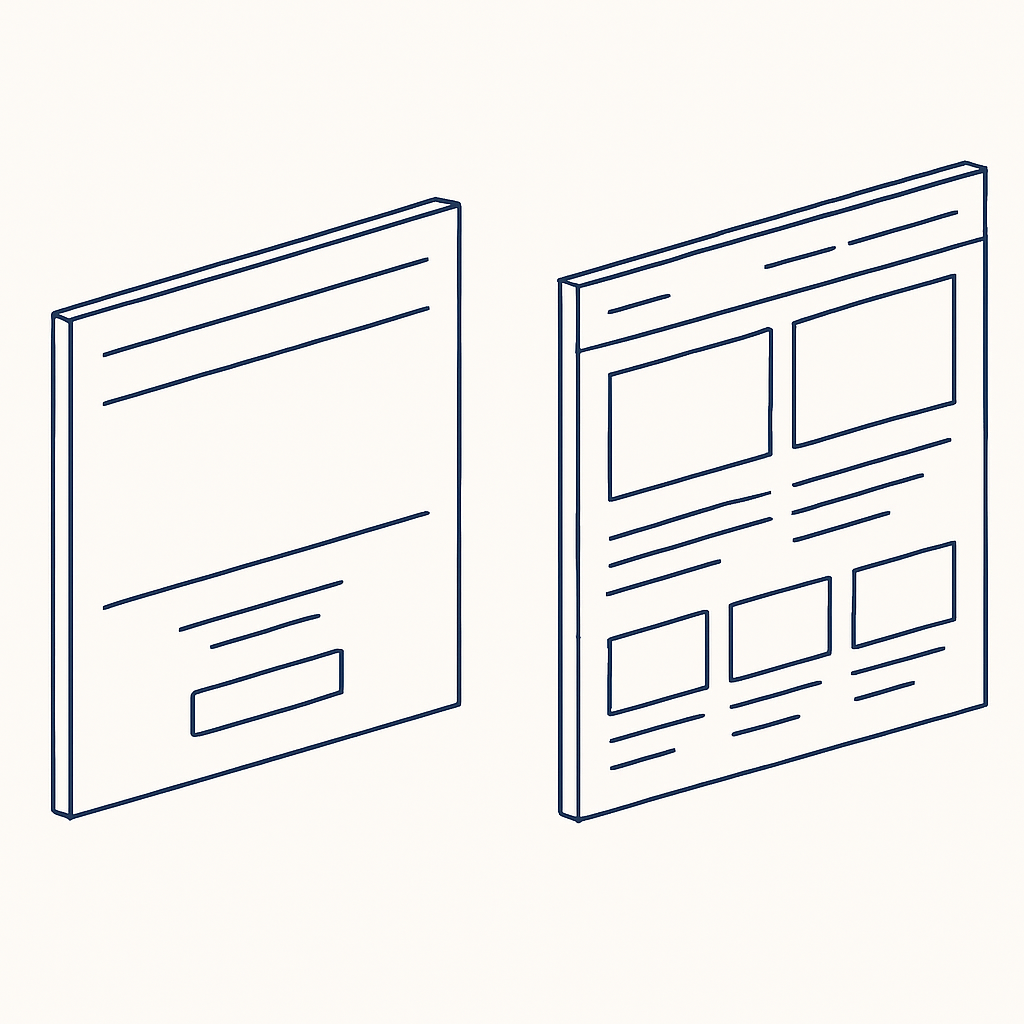
Sending paid traffic to your homepage is one of the most expensive mistakes in digital advertising. It is also one of the most common.
A website and a landing page serve fundamentally different purposes. Using the wrong one for your ad campaign is like answering a specific question with a company brochure. The information is there somewhere, but the person asking had to work too hard to find it, and most of them left before they did.
What a website is actually for
A website serves everyone. It is the company’s permanent presence online, designed to be discovered through search, navigated at a visitor’s own pace, and consumed according to their interests and needs. Good website design anticipates many different visitors with many different intentions and gives all of them a path forward.
That flexibility is the website’s strength in organic contexts. It is also exactly why it fails for paid advertising.
Why paid traffic is different
When someone clicks a paid ad, they are not browsing. They responded to a specific message, for a specific reason, at a specific moment. They have an implicit expectation: that what comes next is a direct continuation of what made them click.
If the ad said “B2B SaaS landing pages that double your conversion rate” and they land on a homepage with twelve navigation options, five service categories, a blog section, and a “work with us” form buried at the bottom, the match is broken. The visitor has to re-orient themselves, find the right thing, figure out if this company can help them with the specific problem they had in mind when they clicked.
Most of them do not. They leave. You paid for the click.
What a landing page is actually for
A landing page is built for one audience, one message, one offer, and one action. That is its entire purpose.
There is no navigation to distract the visitor. There is no other offer to consider. There is no blog post to read instead of converting. Every word, every image, every section is oriented toward a single outcome: getting the visitor to take the one action you want them to take.
This singular focus is what makes landing pages convert at dramatically higher rates than homepages for paid campaigns. The visitor has a specific context and intent. The page matches that context exactly. There is no friction, no navigation, no off-ramp.
The data on this is not ambiguous
Studies across industries consistently find that dedicated landing pages outperform homepages for paid campaigns by a significant margin. When you consider that the average landing page conversion rate sits around 2.35% while the top 25% of pages convert at 5.31% or higher, and that specific, well-matched landing pages regularly exceed 10%, the case for dedicated pages becomes straightforward.
The math on ad spend makes it even clearer. If you are spending $20,000 a month on Google Ads and converting at 2%, that is 400 conversions. Get to 4% with a properly matched landing page, and you have 800 conversions for the same spend. The cost of building the page is recovered almost immediately.
When to use which
Use a landing page for:
- Any paid ad campaign (Google, Meta, LinkedIn, TikTok)
- Specific promotional offers or launches
- Audience-specific messaging (different verticals, company sizes, job titles)
- Webinars, events, or lead magnets
- Any situation where you control the entry point and the visitor context
Use a website (or a specific website page) for:
- Organic search traffic to informational or navigational queries
- Brand discovery through press, social, or word of mouth
- Prospects who have already been converted and are researching you further
- The secondary research a prospect does after seeing your ad and before deciding to convert
These are not competing choices. Strong paid advertising programs use both. The website is the brand’s permanent home. The landing pages are the conversion infrastructure.
The multiple landing page principle
One of the most powerful things a well-structured paid campaign can do is match landing pages to specific ad groups, audiences, or creatives.
A B2B SaaS company running Google Ads might have separate landing pages for “SaaS onboarding improvement,” “trial to paid conversion,” “enterprise SaaS growth,” and “SaaS churn reduction”, each one matching the specific search intent, using the language that searcher would use, and presenting the most relevant case studies and social proof for that audience.
This level of specificity is impossible with a website. And it is exactly what separates median ad performance from the top tier.
The practical implication
If you are running paid campaigns and sending traffic to your homepage, or to a general “services” page, you are leaving a significant portion of your ad spend on the table.
The good news is that a well-designed landing page is not a long-term project. It can be built, tested, and live in a matter of weeks. The lift in conversion rates from page-match optimization typically pays for the investment within the first month.
The question is not whether to use a landing page for your ad campaigns. The question is whether to build them in-house, use a template builder, or work with a specialist agency. That decision depends on your budget, team capacity, and how much the conversion rate improvement is worth to your specific economics.
Landing Page Labs builds dedicated landing pages for B2B and B2C companies running paid ad campaigns. Every project includes strategy, copy, design, and development. Apply to work with us.